Transmission ·9 min
The Key Is Leverage

I remember outlining a video on tech interviews using Claude Code. A few folks in my cohort had asked me what I thought about this practice, more out of confusion I suppose than anything. How are we supposed to figure out whether a candidate is eligible for a job if they use Claude for our interviews?
We could get lost in this question, because honestly: how do you would you know this anyway? Coding intervies are typically horrible, and take home questions require too much time altogether.
Given that people are supposed to use some type of AI tool in their every day coding practice, what are you supposed to do?
I think the answer is obvious: let them. AI is leverage. Let it take you to places you didn’t even consider, and build things you never thought possible.
I’m setting up my fall 2026 cohort based on this theme. If you’re interested, see the note at the end.
Show Me What You Can Do
That’s what I would say if I had to interview someone today. Here’s an hour and a very basic coding question: let’s see what you come up with for, say, Fibonacci.
I like asking Fibonacci questions because it shows you a lot about your candidate, in my mind. It’s like Gordon Ramsey asking other chefs to “make me a f***ing egg”. Eggs aren’t easy to make, whether boiled, scrambled, or fried, it’s very hard to get right.
If you do Japanese martial arts, you’re familiar with the idea of the “kata”, which is a repetetive drill that has you focus on the basics, relentlessly. Master the basics of anything, you master the thing itself.
For me, the Fibonacci sequence is elegant and wonderful, and there are so many ways you can explore the magical mathematics within! I wouldn’t expect you to know a ton about this sequence, or why it’s so wonderful, but I would expect you to be curious about it. That, to me, is the key to using AI with coding: leveraging your curiosity and experience to do something amazing.
How would you do this with Fibonacci? Take a second and pretend I just asked you to fill up an hour with Claude Code - to see what you could come up with. It’s entirely up to you, maybe it’s code, a lecture, a workshop… whatever! Excite me and show me what you can do…
I gave myself 20 minutes and came up with this:
Pisano. The last digit of every Fibonacci number repeats every 60 steps, and always has. The proof is: only m² pairs exist mod m, so you run out and it snaps shut. It tells you a loop exists and then refuses to tell you how long. π(11) is 10, π(10) is 60, no formula.
Zeckendorf. Every integer is a sum of non-consecutive Fibonacci numbers, exactly one way. 17 is 13 + 3 + 1, no second answer. As bits you never see “11”, so “11” becomes a free end marker. That’s a real encoding people use, and it fell out of a rule about rabbits.
Phase space. Plot F(n) against F(n+1) and you get a line with slope φ even though there’s no multiplication. It’s the matrix
[[1,1],[1,0]], eigenvalues φ and -1/φ.
I also came up with some fun graphs and animated them:
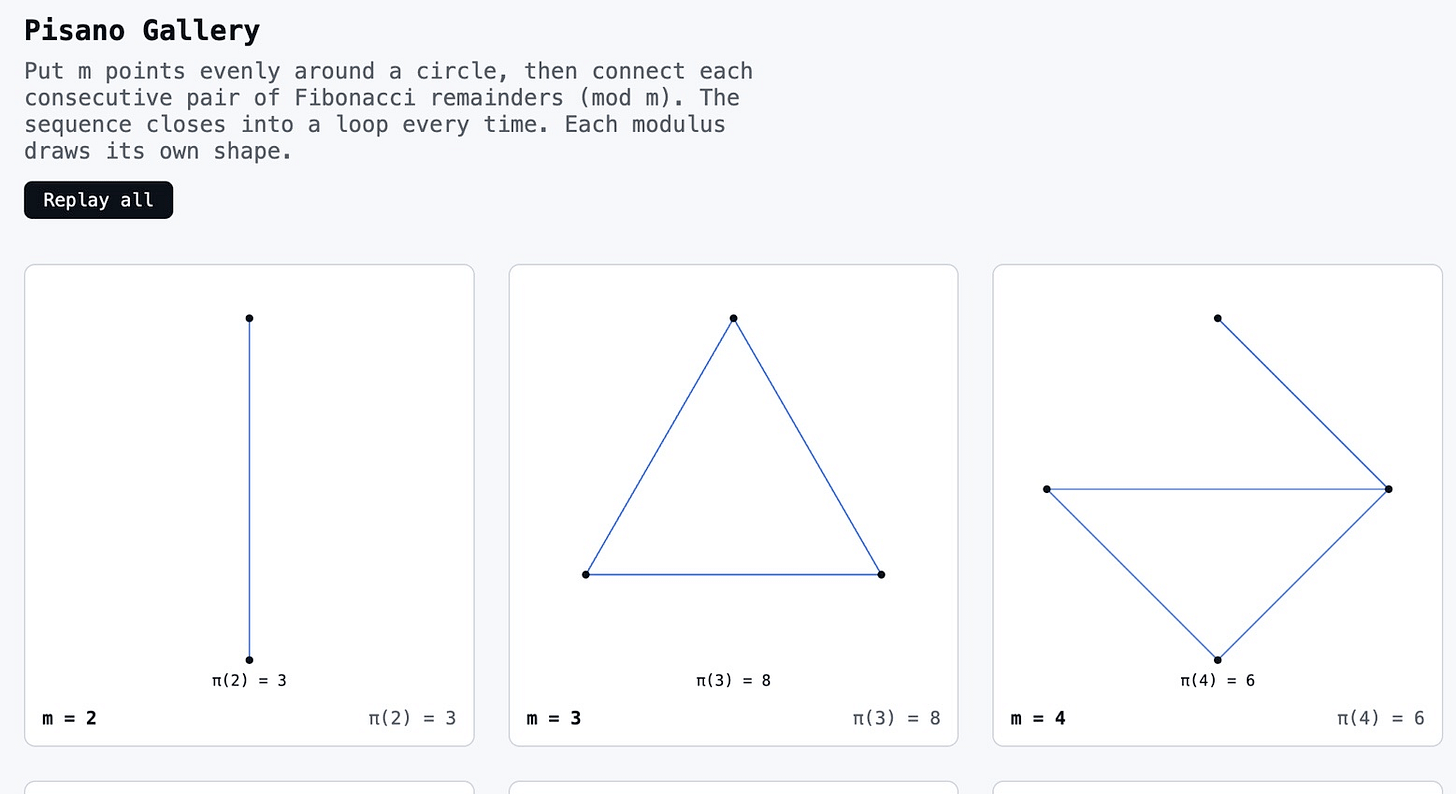
The point is not that I’m amazing and gifted, it’s that I have this space-age intelligence tool here to help expand my thinking, so why do I need to confine it to what I know?
Because Maybe It’s Wrong?
EXACTLY! That’s the very question that you need answered before you hire anyone to do anything: do they know if it’s correct?
You and I can get Claude to tell us anything we like, all day long, but how do we know if it’s correct? When doing Fibonacci math, like above, we have absolutely no idea, do we?
Unless that’s part of our process. This, to me, is where the fun really lives because I don’t know anything about the Pisano dealio and I think I would really love to learn about it. As a candidate, it’s critical to 1) use your curiosity but 2) temper the fire with validation and verification.
Obviously, tests are great for this, as is asking a real life human being. I don’t know any mathematicians off-hand, but I do know how to test things.

For a coding interview, I would want to be sure to “show Claude’s work” but also, to show that I reasonably understand Claude’s work. I had to go through this recently with a client who was running a security scan using some high-end math, and I had no idea what he was talking about.
So I took a few hours, had a coffee, and learned all about his approach. I then explored ways I could repeat back to him what I learned, and in the end we celebrated the gift of knowledge!
In The Real World
So what does this kind of leverage mean, in the real world? It’s one thing to flex in an interview, but what about the every day work you do?
Fair warning: this could possibly get you into trouble.
There are two ways to mess up a project and alienate yourself: doing to much, or doing too little. Which one do you think is worse?
Doing too little slows people down and yes, you could miss a deadline. Doing too much can mean wasted time, going too far, too fast, and causing drama on the team. A cofounder who goes out on day 2 of a fun startup idea and registers a domain, incorporates your company, and sets up a Microsoft 365 account without you knowing is a problem.
I just lived through this, I know.
So let’s pretend you’re given a task for a given sprint. I’ll use something real that I had to make for myself just a month ago (and it’s something I wrote about a few weeks ago too): my email list server.
I used to use ConvertKit (now called Kit) and I liked it, for the most part. Helpful features, some slight networking effect, but overall it was fine and I paid almost $300/month for it.
A few things it struggled with, however:
The analytics are ridiculously hobbled.
No ecommerce numbers to speak of.
No way to trace a campaign or other coordinated effort.
No general “sense” of how the list was doing.
Writing your own list server is a fool’s errand - there is just so much you can get wrong. Go ask Claude what goes into cloning Mailchimp or Kit and see what it says.
For me, however, this was catnip. The trick was to stay focused on the value I was creating, not whether I could get Claude to do silly tricks that would distract me and the effort.
This is the “getting in to trouble” part, and all I can say is that you develop a sense for when it’s happening, over time. For me, when I get inspired, I’ll create a branch and do a quick “what if” conversation with Claude. I just did that 10 minutes ago, asking whether a feedback and comment system was useful.
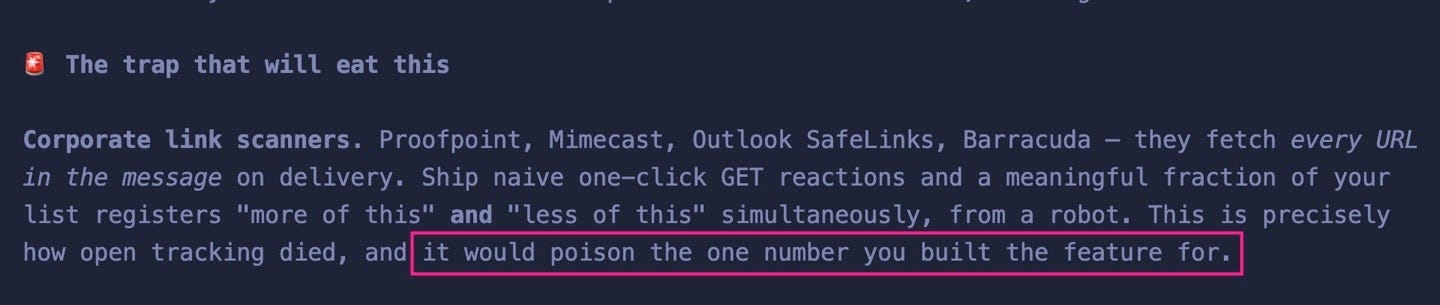
This is the kind of trouble I mean, and it’s avoided through conversation, branching, and a focus on the true value of what you’re building.
The Long Running Dream Made Real
When Fable came out a while back I wanted to see what it could do in terms of lateral thinking. That, to me, is the Good Stuff. Most models can code really well, especially Sonnet and the GPT 5 series. It’s the “well rounded approach” that is the hard part.
Things like “you changed the return type of function X, which resulted in an error in modules A and B so I put in some type checking and added Z as a fallback”. That may or may not be what I want - but either way it tried to “round out” the code changes.
For me, implementing a list server is far more than just blasting out an email. You have to have:
A compelling writing experience, or else you won’t use it.
An auto responder/sequences.
Graceful email sends that don’t take forever, with error tracking and a solid deterministic rule against sending the same person the same thing twice.
A bill that’s < $50/mo (mine is currently $20)
The complete ability to understand whether anyone cares about the stuff you’re writing about.
Obviously there’s a lot more that goes in to it, and it’s a good idea to start with the basics first (sending, unsubbing, a solid data model, cron tasks)… but what else is possible?
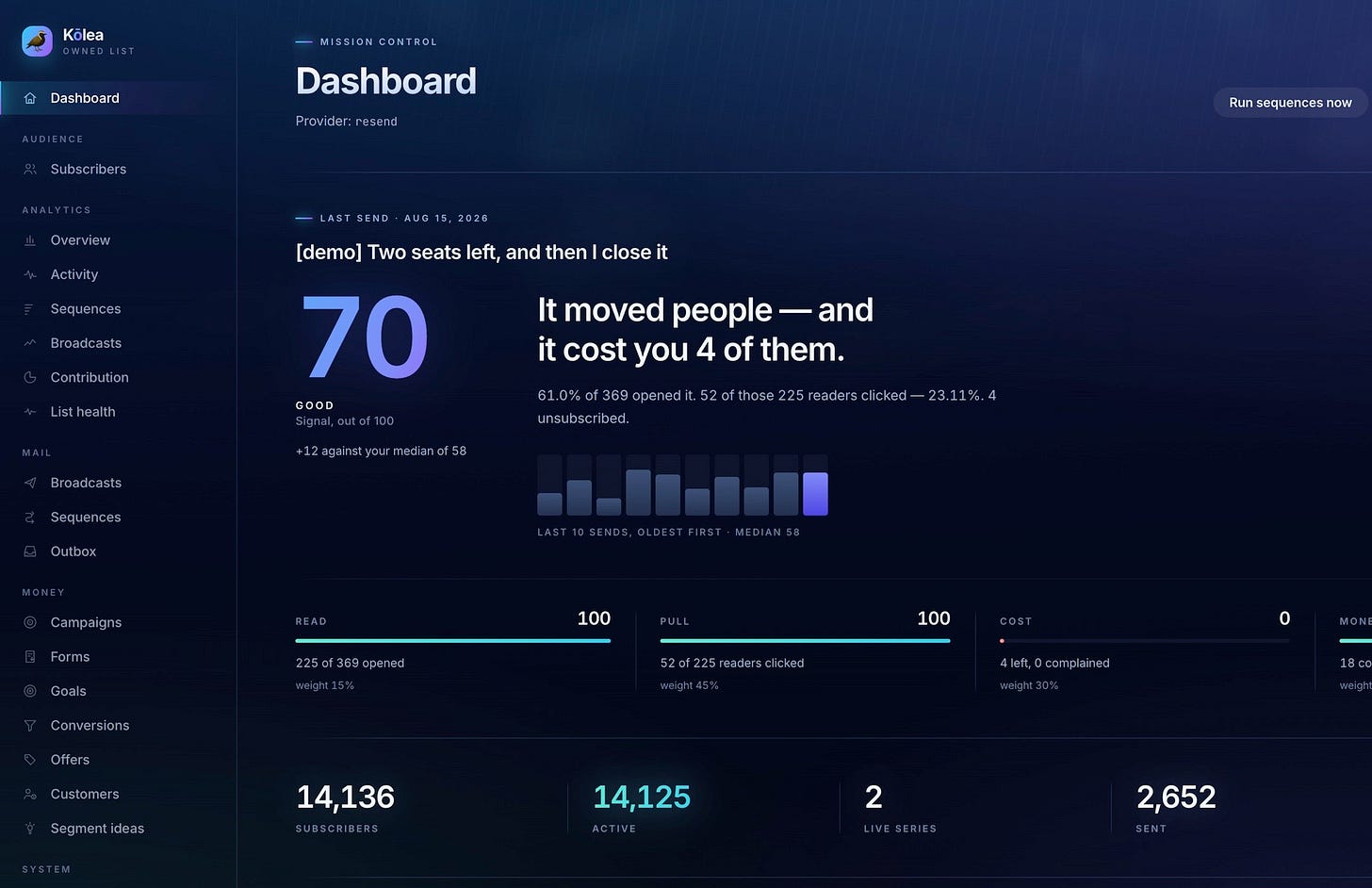
This is Kolea, the result of my month-long effort with Fable, seeing what’s possible when all I want to do is “replace Kit”. What you’re seeing here is demo data, by the way.
I did that, and a whole lot more.
Tell Me What I Don’t Know
When you send email through a service like Resend (my preference), Mailgun, or Sendgrid, they track certain metrics like opens, clicks, unsubs, and more. Most services like Kit track this for you, but that’s about it. I think there’s more we can do here!
So I asked Claude:
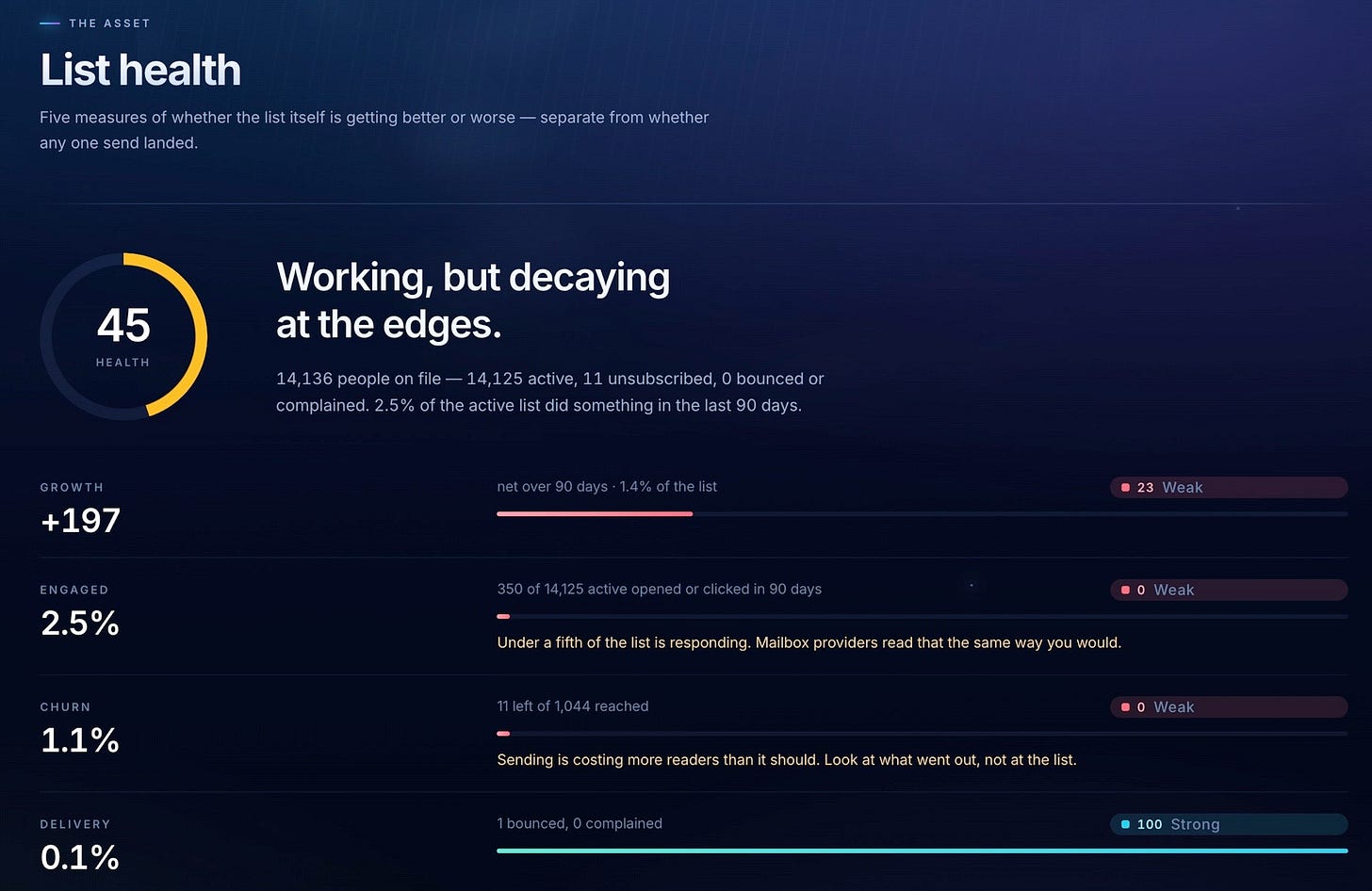
I have all kinds of data I can capture from Resend. Take a look at it and come up with a “metric” that indicates an overall score of engagement, writing effectiveness, subject line, etc.
The prompt was a bit longer, but this is the idea. I then asked it to create a dashboard for me, exploring these numbers and what they mean (again, not real data):
The next thing is segmenting my audience. I could use Claude for this, but I don’t think I need that much intelligence to see what people are interested in based on clicks and reads. So I had another “curiosity session” with Claude and it came up with a really neat way of “auto-segmenting” things for me, based on general interests and things I care about:
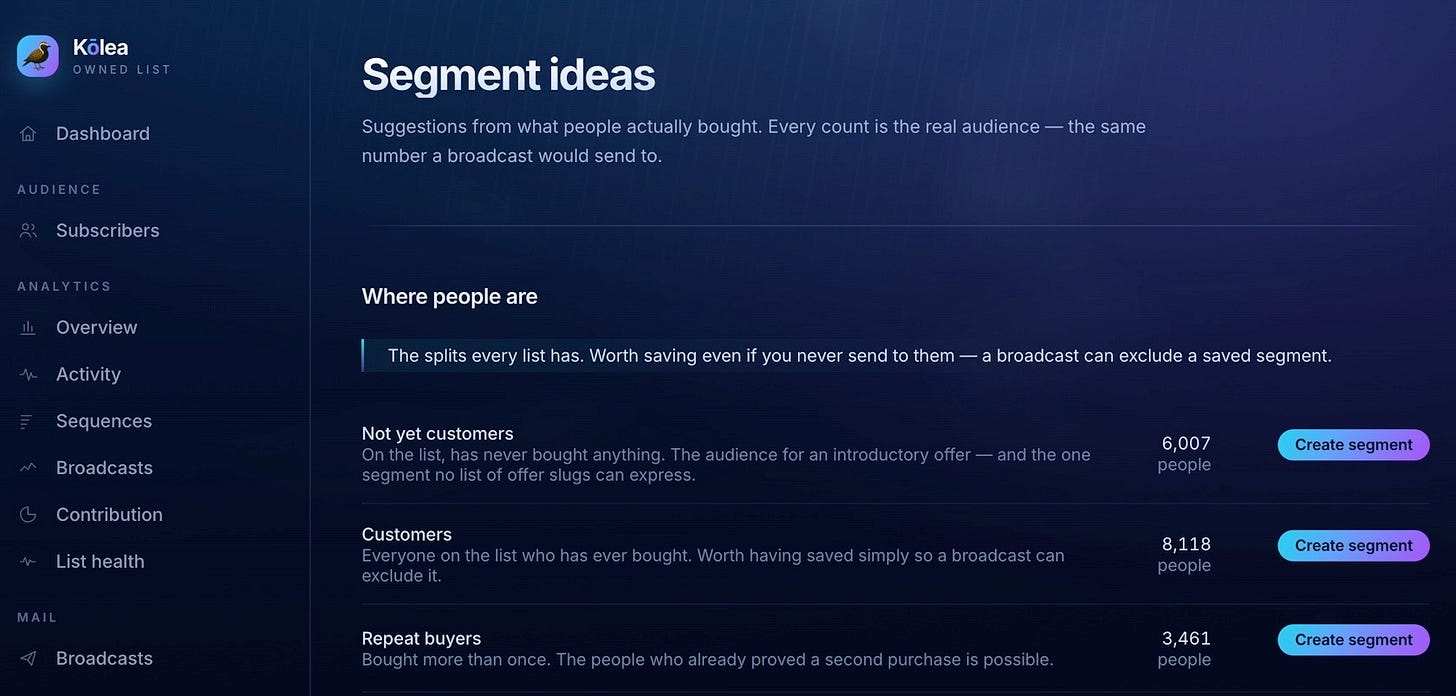
The biggest issue with any email service out there is integration with your sales backend. They all do it very, very poorly and this surprises me.
For instance, an email list server is (typically) your best channel for communicating with your audience and people who might want to buy what you make. Why isn’t this a major focus of every service out there?
I added a Stripe webhook receiver to Kolea and then had a fun conversation with Claude:
I just hooked this list up to Stripe via webhook. I sell books, courses, and subscriptions, as well as a cohort that runs quarterly. I want to see my customer journey here, but I don’t want a full CRM. Just a list server that’s aware of my sales and can tell me when I’m not focusing on things properly.
Again: this is a summary prompt, but you get the idea. What came from this was:
Goals. Yearly, quarterly, or monthly targets for the business.
Campaigns, which are coordinated efforts to meet those goals.
Conversions, which are events that happen when people reading the list find value and buy.
Forms for signups and lead magnets.
This is getting in to marketing stuff and honestly, I am still getting used to doing it. I love writing and don’t like to think of it as a “sales tool” but, all the same, tracking what people care about it is a thing, isn’t it?
Anyway: all of this is now in place and working dandy.
Customization and Deployment
This entire thing is open source and I don’t want to make any money from it because it’s a learning thing for me, and if it can help someone else, yay!
It’s ready for expansion if you need, with a .claude directory full of great skills, and instructions on how to enchance and expand. There are all kinds of docs on architecture, installation, the project plan, and the README has everything you need if you want to set this up.
Speaking of: it runs on Cloudflare workers and the D1 database, and if you want to take advantage of sequences, you’ll need the $5/mo worker plan. You can send email through Resend (my recommendation) which has a massive generous free tier. The sender is pluggable, so swapping out for Amazon SES is trivial.
Images are wired up for S3 storage and the editor is TipTap with every plugin I could think of wired up (TipTap is a block editor that supports markdown and is brilliant):
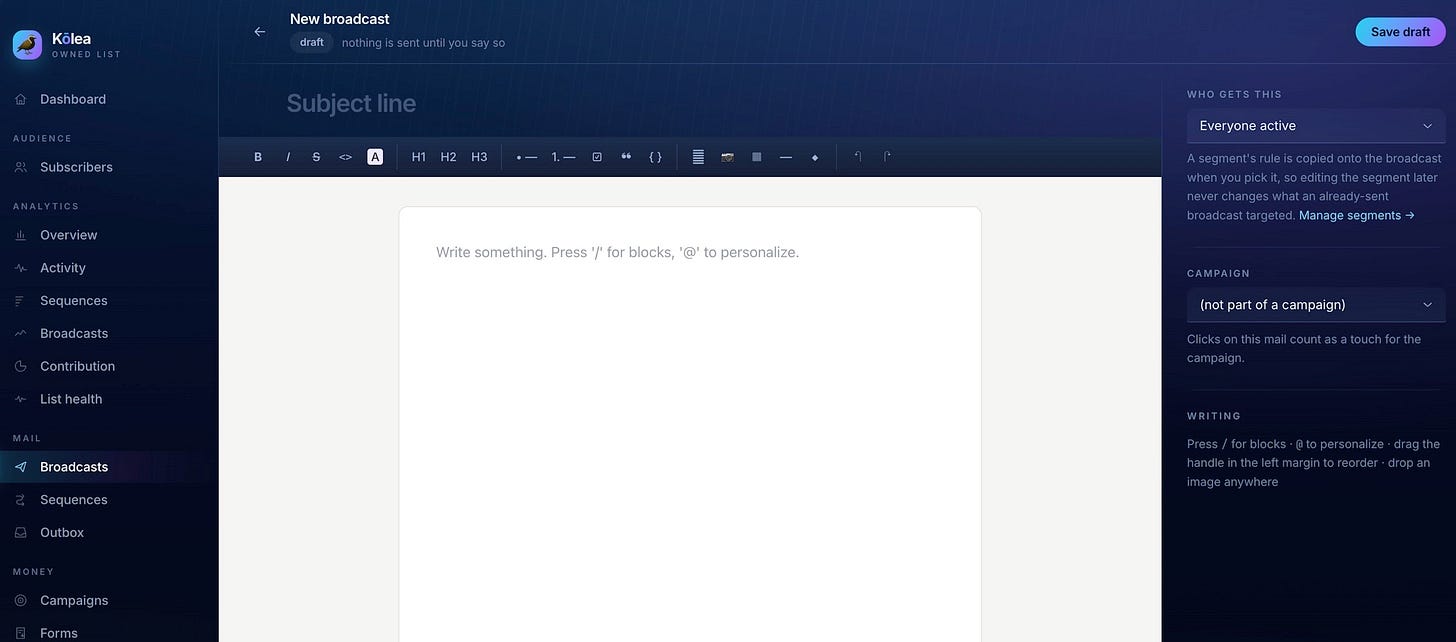
Every email is sent with a link to a public/web-based version, and I’m pondering whether to add comments. I might, but I want to see how this ages first.
Syntax highlighting, fully responsive, and what I consider to be a gorgeous interface.
I love this thing, and that’s the point.
Take It and Run
I could have stopped at the broadcasts and auto-responder stuff, but where’s the fun in that? I wanted to build something that blew my damned mind, and destroyed what’s possible in terms of SaaS offerings. I honestly don’t think you can find something like this out there right now, but maybe I’m biased and wrong.
AI is leverage. Let it take you to places you didn’t even consider, and build things you never thought possible. This is the state of play of our industry, and it’s not good enough to be good enough.
Thanks for reading! Love to read your comments on this…
Rob
P.S. If you’re interested in the idea of leveraging AI, I’m setting up the fall cohort and using this as the topic. Have a look here.