Transmission ·4 min
30 minutes, three prototypes of one idea
We’re on the last week of the Fall 2026 cohort and today’s session was one that I have been looking forward to for a very long time: Build It! Day.
It’s not too late to join us! I record, edit, and post every session the day it happens. You can watch today’s if you want, just sign up right here.
We have explored so many topics throughout the sessions and today we got to put them all together, seeing what true leverage is all about. We had so much fun I just couldn’t keep it to myself, so I figured I would share what we did.
The Focus: Just Build It
AI gives us tremendous power as software developers, to the point of complete overwhelm. It’s so easy to create just about anything, that we end up creating nothing at all. It’s akin to having a magic wand: if something is easy to attain, does it have any value at all?
I could barrage you with quotes and philosophical musings, but let’s just skip all that and get to the good stuff, shall we?
Here’s how we started the day:
Here’s an
idea-pipelineskill. Take your idea, run it through the pipeline, and see if the result is something you like or need, or that someone would pay money for.
What you end up with, after the pipeline has run, is a workable, gorgeous prototype that you either love or that you’re willing to shelve because it doesn’t grab you.
The skill use’s Karpathy’s “council” idea, where you have multiple agents argue over something (or ponder, resonate, whatever) instead of just having a single conversation with the main thread. For this skill, there are three councils, all with a single job:
The first council is built using Noah Kagan’s Million Dollar Weekend framework, and the entire goal is “is this idea worth pursuing?” It does market research, guages demand, looks at effort and how long it will take to make $1M, and either kills the idea or reframes it a bit so it will pass the first gate.
The second council is about resonance and exploration. You shouldn’t have to think through all the ways your idea could be expanded (though you can if you want) - leave it to some agents to do that for you!
The final council refines the idea and trims off the rough edges that the second council came up with. It builds a cohesive story, and then from that story, comes up with three variants as prototypes.
That’s it. If this seems interesting, you can download the skill here and have some fun!
When Vibe Coding Works
To be clear: the result is a prototype, and not really meant to be deployed live. I wanted to be able to spend 30 minutes to play with the idea in my head (well, three versions of it really) and then to see it come to life.
That, people, is leverage.
If I like the idea, I have something I can expand upon. I can hand it off to T3, Herdr, or Claude Code and throw my architecture skills at it, hopefully creating something that’s won’t fall over.
This, to me, is the power of vibe-coding. In the hands of a senior programmer, being able to prototype something by feels is a tremendous advantage. We know what it might take to get the thing up and in front of people, and also what it will take to maintain it.
The problem we have, I think, is between the ears.
We Don’t Want to Be Vibe Coders, Do We?
Programming is a weird business in that it’s full of very smart people and, if you’re self-taught like me, you deal with these smart people all the time. You hear them discuss concepts and processes that fly right over your head, and you do your best not to feel stupid.
So when one of these smart people sneers at some AI-generated app and calls it “vibed out slop”, we instantly know that this is a thing we must never create, because the smart coder people will sneer at us too and we’ll be cast out.
I think these people might actually exist in the real world somewhere, but they for-sure exist everywhere in my mind, and it takes a lot of effort to get them to shut it.
Vibe coding absolutely has a place in our workflow. It happens when our imagination is fully engaged and humming, when our thinking mind needs to have a seat and let our creativity drive for a while.
That doesn’t make us vibe-coders, it makes us human.
Create Something Gorgeous!
You have the skill, so let your freak flag fly! Make the thing you’ve always wanted, or get off the couch tonight when that idea strikes! Maybe you’re like me, with your best ideas hitting you on a walk, or in the shower.
Create a reminder with your watch, hand it off to Claude with the /idea-pipeline skill, and see what comes of it!
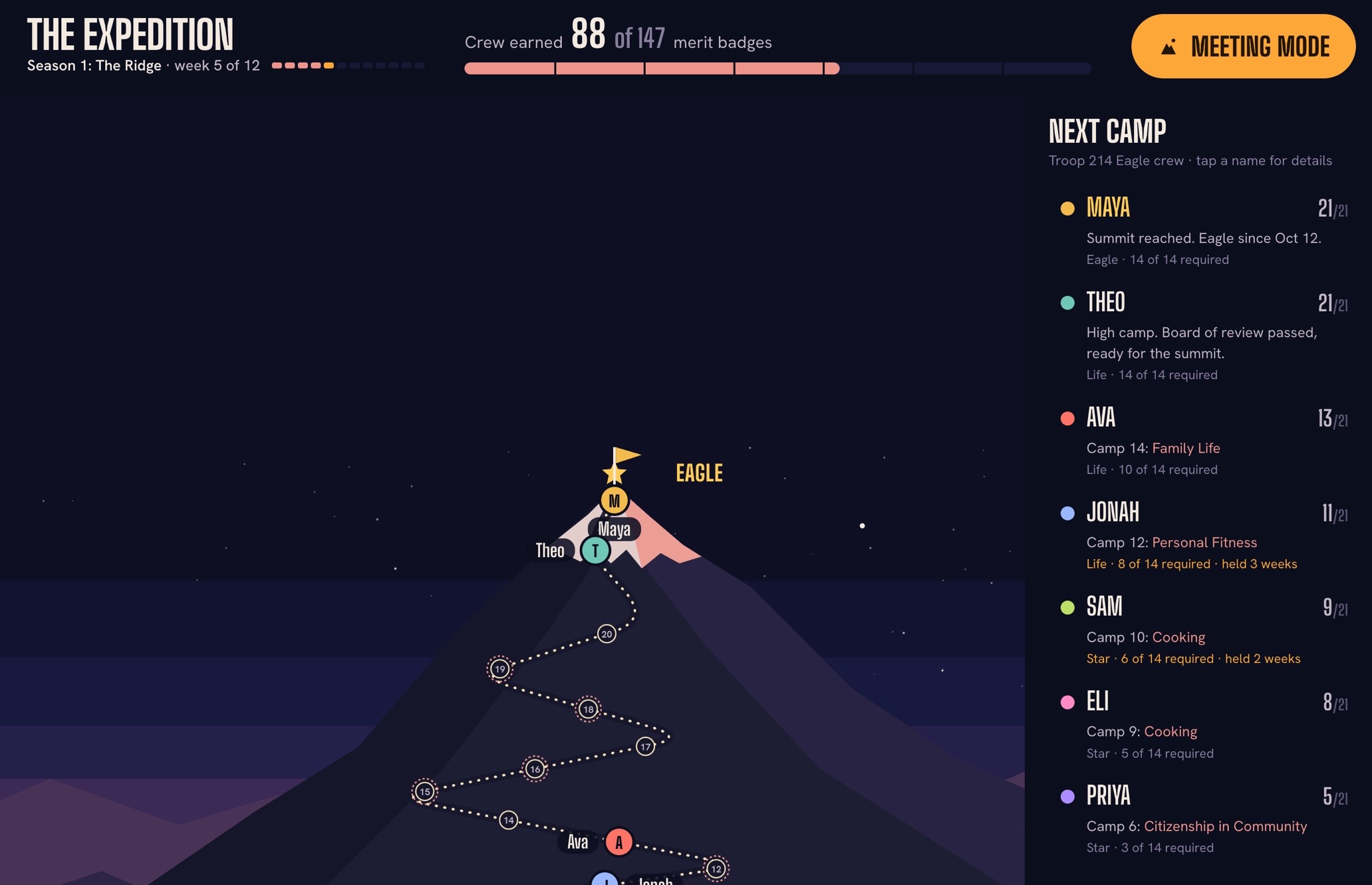
Maybe you’ll create an app that gamifies the Eagle Scout experience (credit to Chris G. for the inspiration):
Another participant, Brendan, created a wonderful gift-tracker app that also helped you send thank you cards.
Paul made an app that I said we should call “Better Stop Calling Paul”, that is a crowd-sourced explainer app that helps people work the equipment at his church (projectors, router, etc). He then went on to have Claude use ElevenLabs and some video making skills so people have an explainer video, in his voice, to go along with it.
These are people with decades of experience, feeling the joy of creativity and what’s possible with AI. Letting go of the “we don’t vibe code here” dark cloud, and exploring what it means to truly create something fun and interesting.
This was easily the best session of the group so far, and the next one will be even more fun as we apply our knowledge and turn these prototypes into something real.
You Can Still Join Us
I have recorded and edited every session of the cohort, and if you’d like to see what we came up with today, and how we got there, you certainly can! You can watch all of the videos and, if you have any questions, you can email me and I’ll answer them as part of the whole gig:
To be clear: these aren’t just a bunch of videos where you watch people rambling. I have edited them tightly and sprinkled some production value in there to make them as engaging as possible.
Come join us, and see how you can leverage what you do, without feeling like a vibe coder.