Transmission ·4 min
Opus 5 is changing the possibilities here
The shift to AI programming presents a number of problems that we need to figure out as senior developers: crap code, vibed nonsense, and skill erosion - to name a few.
To me, the bigger problem is a bit more subtle: we can literally make anything we want to. Or at least it feels that way.
For instance: this here is Koa, a fun little app I made while editing my latest course, Working with a Massive Codebase (more on that below):
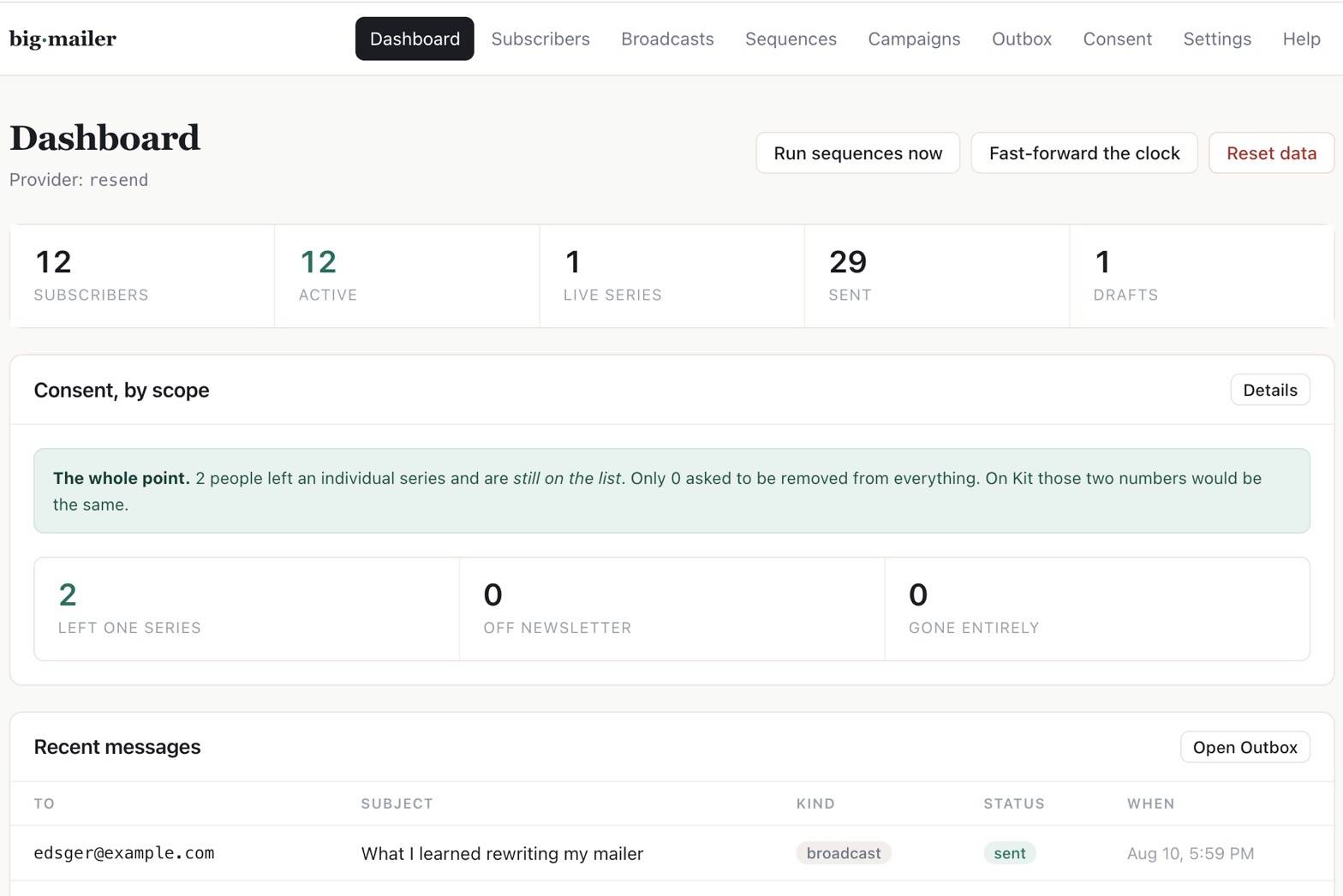
Koa is a newsletter application (like Mailchimp or Kit, but just for me) that works with Cloudflare and Resend, and it will queue and send 10K emails in just under 2 minutes using Cloudflare's infrastructure. There are all kinds of protections in place to prevent abuse, statistics, and... well lots of stuff. List services like this are extremely nuanced and difficult to get right.
I'm probably going to start using Koa in the next few months when I get a moment to breath. It was quite literally a side project that came from me wanting to see what Opus 5 could do.
And let's just say it can do a lot; far more than any other model I've used to this point, and I find that it's easier than ever to clone a service or app that I like, and make it my own.
But I'm getting off the point, and I'll write more about Koa and what it took to get it live, in a later note. For now, I need to get back on track...
How Hard Could That Be?
I'm having the same dangerously silly feeling I had when I first learned to code and I felt like I could create anything. Remember that feeling? When you would casually tell a friend that "I could build that in a weekend!" or "an email list service? You're just sending out a bunch of emails at once, how hard could that be?"
Don't lie - you've said this! I sure have, but that was many, many years ago. As time goes on and the scars pile up, your tolerance for risk goes way, way down. You've been burned a few times, and you also begin to fully understand the weight of keeping a long-running application or library maintained. That's truly the hard part of software development! Creating things is easy, keeping them from falling over is a whole different game.
Until now. Opus 5 is just so, so good, that testing, refactoring, adjusting, and optimizing have become so simple - you just have to know what you're doing so Opus knows what it needs to do.
Maybe If I Just...
I have a lot of ideas and I mentioned one in a particular a few weeks back: I'm going to clone VS Code because I want to build an editor that make sense in this agentic coding age. I don't want progress cards with agent names, or planning checklists, or sequence diagrams showing agent trees. Those a boring.
I want something that tells me the code doesn't suck, that the tests make sense and actually test something that needs testing. I want visuals of architecture and a sense of "where we are" when it comes to building things out.
That's what Working With a Massive Codebase is all about: I'm building the thing I want because I can, using Opus 5. I would never have said that 6 months ago because I tried and failed, many times, to build complex things. Kit (the mail service I'm using to send this note) has been on my radar for over a year! No model was good enough to help me think through its complexity - until Opus 5 bult Koa for me (see above).
VS Code is millions of lines of code and I would have to be an absolute delusional idiot to think I could do this on my own with Claude Code. Over 10 years of history in this thing, led by none other than Erich Gemma himself (he's 1/4 of the Gang of Four, if you didn't know).
And yet.
I Have Opus 5. I Can Do This Thing.
We didn't go to the moon by being careful. We took our time, tackled each problem individually as it appeared. We adjusted, and moved forward.
I'm ripping Copilot out of VS Code and stripping the thing down to its core so I can build what I want to see. This is likely folly, and I'm recording every single episode live, though yes, I am editing it for watchability. I truly have no idea if it's going to work, but I damned sure am going to find out.
We need to push beyond the idea of coding an application to see what's possible, friendos, and part of that is letting go of the fear of failing.
I will face my fear. I will permit it to pass over me and through me. And when it has gone past I will turn the inner eye to see its path. Where the fear has gone there will be nothing. Only I will remain \[with an extra bitchen agentic code editor\].
I hope you join me! I have 11 or so episodes in the can, with 4 published as of right now. I've been recording as I can (barring the random Category 1 hurricane, which just knocked me into the real world for 3 days as I had no power or cell service).
I'm also recording these around the release of Upgrading a Legacy Application, another fun production I'm doing with Jon Skeet, where we use Claude Code to upgrade SubSonic 2.x (an ORM I created in 200. We've been delayed on that a little - see hurricane note above - but both productions should be done by September).
And, if all goes well, I'll have a shiny new editor that completes my vision. My own personal fork of VS Code that does what I want, without the nonsensical nonsense of a startup or massive corporation.
If you have any queastions about any of these things, pop on over to our Discord! I just set it up and am absolutely loving it! I tried Circle for a bit and it ... well let's just say it wasn't for me.
Am I Nuts?
Tell me what you think! I read all my replies and usually respond (if warranted), but I'm curious if you think I'm on a fool's errand, or if there's something here.
I promise that if I respond, it will be from my fingers and my own brain - no AI. Just like this note here!
Thanks for reading!
Rob
* *
I help business get the most out of AI doing the simplest possible things. Have a look here if you think I can help!
Come join our Discord!